Who Ate the Porridge of the Baby Bear
| Goldilocks and the Three Bears | |
|---|---|
| by Robert Southey | |
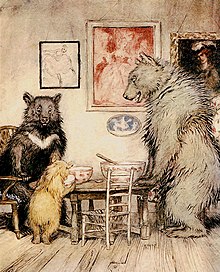 Illustration by Arthur Rackham, 1918, in English Fairy Tales by Flora Annie Steel | |
| Land | Great britain |
| Genre(s) | Fairy tale |
| Published in | The Doc |
| Publication type | Essay and story collection |
| Publisher | Longman, Rees, etc. |
| Media type | |
| Publication date | 1837 |
| Text | Goldilocks and the Three Bears at Wikisource |
"Goldilocks and the Iii Bears" (originally titled "The Story of the Three Bears") is a 19th-century British fairy tale of which three versions exist. The original version of the tale tells of a non-and then-polite old woman who enters the forest home of iii available bears while they are away. She sits in their chairs, eats some of their soup, sits downwardly on one of their chairs and breaks it, and sleeps in i of their beds. When the bears render and discover her, she wakes up, jumps out of the window, and is never seen again. The second version replaced the sometime woman with a little daughter named Goldilocks, and the third and by far all-time-known version replaced the original bear trio with Papa Acquit, Mama Acquit, and Baby Bear.
What was originally a frightening oral tale became a cozy family unit story with but a hint of menace. The story has elicited various interpretations and has been adapted to film, opera, and other media. "Goldilocks and the 3 Bears" is 1 of the nearly popular fairy tales in the English language linguistic communication.[1]
Plot [edit]

Illustration in "The Story of the Three Bears" second edition, 1839, published by West. N. Wright of sixty Drapery Mall, London
In Robert Southey's version of the tale, three anthropomorphic bears – "a little, small, wee comport, a centre-sized comport, and a keen, huge acquit" – live together in a house in the woods. Southey describes them as very good-natured, trusting, harmless, tidy, and hospitable. Each of these "bachelor" bears has his own porridge bowl, chair, and bed. One day they brand porridge for breakfast, but it is likewise hot to eat, so they decide to take a walk in the woods while their porridge cools. An old adult female approaches the bears' house. She has been sent out by her family because she is a disgrace to them. She is impudent, bad, foul-mouthed, ugly, muddied, and a vagrant deserving of a stint in the House of Correction. She looks through a window, peeps through the keyhole, and lifts the latch. Assured that no one is home, she walks in. The quondam adult female eats the Wee Bear's porridge, then settles into his chair and breaks it. Prowling about, she finds the bears' beds and falls comatose in Wee Behave's bed. The end of the tale is reached when the bears return. Wee Bear finds his empty bowl, his broken chair, and the sometime woman sleeping in his bed and cries, "Somebody has been lying in my bed, and here she is!" The old woman wakes, jumps out the window and is never seen again.
Origins [edit]
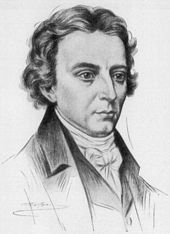
The story was outset recorded in narrative form by English language writer and poet Robert Southey, and outset published anonymously as "The Story of the Three Bears" in 1837 in a book of his writings called The Doctor.[2] The same year Southey's tale was published, the story was versified by editor George Nicol, who acknowledged the anonymous writer of The Doctor as "the great, original concocter" of the tale.[3] [four] Southey was delighted with Nicol'due south endeavor to bring more exposure to the tale, concerned children might overlook it in The Physician.[5] Nicol's version was illustrated with engravings by B. Hart (after "C.J."), and was reissued in 1848 with Southey identified as the story's writer.[6]
The story of the 3 bears was in apportionment earlier the publication of Southey's tale.[vii] In 1813, for example, Southey was telling the story to friends, and in 1831 Eleanor Mure fashioned a handmade booklet well-nigh the three bears and the old woman for her nephew Horace Broke'south birthday.[3] Southey and Mure differ in details. Southey'south bears accept porridge, but Mure'due south have milk;[3] Southey's old woman has no motive for inbound the business firm, but Mure'southward old woman is piqued when her courtesy visit is rebuffed;[eight] Southey's old woman runs away when discovered, but Mure's old woman is impaled on the steeple of St Paul's Cathedral.[9]
Folklorists Iona and Peter Opie point out in The Classic Fairy Tales (1999) that the tale has a "partial analogue" in "Snow White": the lost princess enters the dwarfs' firm, tastes their food, and falls asleep in 1 of their beds. In a way similar to the iii bears, the dwarfs cry, "Someone's been sitting in my chair!", "Someone's been eating off my plate!", and "Someone's been sleeping in my bed!" The Opies as well bespeak to similarities in a Norwegian tale about a princess who takes refuge in a cavern inhabited by 3 Russian princes dressed in bearskins. She eats their food and hides under a bed.[x]
In 1865, Charles Dickens referenced a like tale in Our Mutual Friend, but in that story the house belongs to hobgoblins rather than bears. Dickens' reference however suggests a yethoped-for-discovered counterpart or source.[11] Hunting rituals and ceremonies accept been suggested and dismissed as possible origins.[12] [13]

"Scrapefoot" illustration past John D. Batten in More English Fairy Tales (1895)
In 1894, "Scrapefoot", a tale with a fox equally adversary that bears hitting similarities to Southey's story, was uncovered by the folklorist Joseph Jacobs and may predate Southey's version in the oral tradition. Some sources country that information technology was illustrator John D. Batten who in 1894 reported a variant of the tale at least 40 years old. In this version, the three bears alive in a castle in the woods and are visited by a fox chosen Scrapefoot who drinks their milk, sits in their chairs, and rests in their beds.[3] This version belongs to the early Fox and Bear tale-bicycle.[14] Southey maybe heard "Scrapefoot", and confused its "vixen" with a synonym for an unpleasant malicious old woman. Some maintain withal that the story every bit well equally the old woman originated with Southey.[ii]
Southey most likely learned the tale as a child from his uncle William Tyler. Uncle Tyler may have told a version with a vixen (female trick) as the intruder, and and then Southey may take later confused "vixen" with another mutual meaning of "a crafty old woman".[three] P. M. Zall writes in "The Gothic Voice of Father Conduct" (1974) that "it was no trick for Southey, a complete technician, to recreate the improvisational tone of an Uncle William through rhythmical reiteration, aesthetic ingemination ('they walked into the woods, while'), fifty-fifty bardic interpolation ('She could non have been a expert, honest Former Woman')".[fifteen] Ultimately, information technology is uncertain where Southey or his uncle learned the tale.
Later on variations: Goldilocks [edit]

London based writer and publisher Joseph Cundall changed the antagonist from an onetime woman to a girl
Twelve years after the publication of Southey's tale, Joseph Cundall transformed the antagonist from an ugly sometime woman to a pretty little girl in his Treasury of Pleasure Books for Young Children. He explained his reasons for doing so in a dedicatory letter to his children, dated November 1849, which was inserted at the beginning of the book:
The "Story of the Three Bears" is a very old Nursery Tale, just it was never so well told as past the great poet Southey, whose version I have (with permission) given you, only I have made the intruder a petty girl instead of an quondam woman. This I did because I found that the tale is better known with Silver-Hair, and because there are so many other stories of old women.[10]
Once the footling daughter entered the tale, she remained – suggesting children prefer an attractive child in the story rather than an ugly onetime woman.[5] The juvenile antagonist saw a succession of names:[xvi] Silvery Hair in the pantomime Harlequin and The Iii Bears; or, Little Silver Hair and the Fairies past J. B. Buckstone (1853); Silver-Locks in Aunt Mavor's Nursery Tales (1858); Silverhair in George MacDonald's "The Golden Key" (1867); Gilded Hair in Aunt Friendly's Nursery Volume (ca. 1868);[10] Argent-Hair and Goldenlocks at various times; Fiddling Golden-Hair (1889);[14] and finally Goldilocks in Old Nursery Stories and Rhymes (1904).[ten] Tatar credits English author Flora Annie Steel with naming the child in English Fairy Tales (1918).[2]

Goldilocks'southward fate varies in the many retellings: in some versions, she runs into the wood, in some she is about eaten by the bears merely her female parent rescues her, in some she vows to be a good kid, and in some she returns dwelling house. Whatever her fate, Goldilocks fares better than Southey's vagrant onetime adult female who, in his opinion, deserved a stint in the House of Correction, and far amend than Miss Mure's old adult female who is impaled upon a steeple in St Paul's church building-yard.[17]
Southey'due south all-male person ursine trio has not been left untouched over the years. The group was re-cast as Papa, Mama, and Baby Conduct, but the date of this change is disputed. Tatar indicates it occurred past 1852,[17] while Katherine Briggs suggests the event occurred in 1878 with Mother Goose's Fairy Tales published by Routledge.[14] [xvi] With the publication of the tale by "Aunt Fanny" in 1852, the bears became a family in the illustrations to the tale only remained three bachelor bears in the text.
In Dickens' version of 1858, the two larger bears are blood brother and sister, and friends to the trivial behave. This system represents the evolution of the ursine trio from the traditional three male bears to a family of father, mother, and kid.[eighteen] In a publication c. 1860, the bears take become a family at last in both text and illustrations: "the old papa comport, the mama behave, and the little boy behave".[19] In a Routledge publication c. 1867, Papa Conduct is called Crude Bruin, Mama Bear is Mammy Muff, and Babe Bear is called Tiny. Inexplicably, the illustrations describe the three equally male bears.[xx]
In publications subsequent to Aunt Fanny's of 1852, Victorian nicety required editors to routinely and silently alter Southey's "[T]here she sate till the bottom of the chair came out, and down came her'southward, plump upon the ground" to read "and down she came", omitting any reference to the man bottom. The cumulative result of the several changes to the tale since its original publication was to transform a fearsome oral tale into a cozy family story with an unrealised hint of menace.[xvi]
Interpretations [edit]
Maria Tatar, in The Annotated Classic Fairy Tales (2002), notes that Southey'south tale is sometimes viewed as a cautionary tale that imparts a lesson about the hazards of wandering off and exploring unknown territory. Like "The Tale of the Three Fiddling Pigs", the story uses repetitive formulas to engage the child's attention and to reinforce the point nigh safety and shelter.[17] Tatar points out that the tale is typically framed today as a discovery of what is "just correct", but for earlier generations, it was a tale about an intruder who could not control herself when encountering the possessions of others.[21]

Illustration past John Crossbar, 1890
In The Uses of Enchantment (1976), the child psychologist Bruno Bettelheim describes Goldilocks equally "poor, beautiful, and charming", and notes that the story does not describe her positively except for her hair.[22] Bettelheim mainly discussed the tale in terms of Goldilocks' struggle to move past Oedipal issues to face up adolescent identity problems.[23]
In Bettelheim'southward view, the tale fails to encourage children "to pursue the hard labor of solving, one at a time, the problems which growing up presents", and does not stop as fairy tales should with the "promise of future happiness pending those who take mastered their Oedipal situation as a child". He believes the tale is an escapist one that thwarts the child reading it from gaining emotional maturity.
Tatar criticises Bettelheim's views: "[His] reading is perhaps too invested in instrumentalizing fairy tales, that is, in turning them into vehicles that convey letters and fix along behavioral models for the child. While the story may not solve oedipal problems or sibling rivalry as Bettelheim believes "Cinderella" does, it suggests the importance of respecting property and the consequences of just 'trying out' things that do non belong to you."[17]
Elms suggests Bettelheim may have missed the anal aspect of the tale that would make it helpful to the kid'south personality development.[22] In Handbook of Psychobiography Elms describes Southey's tale not as i of Bettelheimian post-Oedipal ego development but as one of Freudian pre-Oedipal anality.[23] He believes the story appeals importantly to preschoolers who are engaged in "cleanliness training, maintaining environmental and behavioral social club, and distress about disruption of order". His own feel and his observation of others atomic number 82 him to believe children align themselves with the tidy, organised ursine protagonists rather than the unruly, delinquent man antagonist. In Elms's view, the anality of "The Story of the Three Bears" can be traced directly to Robert Southey'southward fastidious, dirt-obsessed aunt who raised him and passed her obsession to him in a milder form.[23]
Literary elements [edit]
The story makes extensive use of the literary rule of three, featuring three chairs, iii bowls of porridge, iii beds, and the iii title characters who live in the house. There are also 3 sequences of the bears discovering in turn that someone has been eating from their porridge, sitting in their chairs, and finally, lying in their beds, at which indicate is the climax of Goldilocks existence discovered. This follows three before sequences of Goldilocks trying the bowls of porridge, chairs, and beds successively, each time finding the third "only right". Author Christopher Booker characterises this every bit the "dialectical three", where "the commencement is wrong in one way, the second in another or opposite way, and only the third, in the middle, is just right". Booker continues: "This idea that the way forwards lies in finding an exact middle path between opposites is of extraordinary importance in storytelling".[24] This concept has spread across many other disciplines, particularly developmental psychology, biology, economics, and engineering where information technology is chosen the "Goldilocks principle".[25] [26] In planetary astronomy, a planet orbiting its lord's day at just the correct distance for liquid h2o to exist on its surface, neither too hot nor also cold, is referred to equally being in the 'Goldilocks Zone'. As Stephen Hawking put information technology, "like Goldilocks, the development of intelligent life requires that planetary temperatures be 'simply right'".[27]
Adaptations [edit]
Animated shorts [edit]
The Three Bears [edit]
A brusque picture show by Terrytoons titled The Three Bears was released in 1934 and remade in 1939. These shorts depict the bears equally having stereotypical Italian accents and mannerisms. Likewise, instead of eating porridge, they consume spaghetti. The scene where Papa Bear says "Somebody touched my spaghetti!" became a viral Net meme on YouTube during late 2017, beingness known as "Somebody toucha my spaghet!" The bears are not really blackness, they are dark-brown, withal the print of this short which most people are familiar with is faded in such a way that they announced to have blackness fur.
Others [edit]
- The MGM cartoons of the tardily 1930s included a Bear Family unit subseries by Hugh Harman based on the story, starting with Goldilocks and the Iii Bears (1939), so continuing on to A Rainy Mean solar day with the Bear Family (1940) and Papa Gets the Bird (1941). The MGM character of Barney Bear, originating concurrently, was at times advertised every bit beingness this Bear Family's Papa, though creator Rudolf Ising appears to have always intended him as a split character.
- Goldilocks and the Jivin' Bears is a 1944 Merrie Melodies cartoon directed by Friz Freleng.[28] : 154
- Bugs Bunny and the Iii Bears is a 1944 Merrie Melodies cartoon brusque directed by Chuck Jones.[28] : 148 The brusque was released on February 26, 1944, and features Bugs Bunny.[29]
- The Looney Tunes and Merrie Melodies cartoons include a prominent Iii Bears family, distinguished past a brusk, irascible father, a deadpan mother, and a huge, oafish 7-yr-one-time "kid", still in diapers. Jones brought back the Bears for his 1948 cartoon What'south Brewin', Bruin?, this time without Bugs.[28] : 182 Here, Papa Bear decides that it'south time for the Bears to hibernate; however, various disturbances interfere. Junior'southward voice is hither supplied by Stan Freberg. Other Three Bears cartoons included Bear Feat, released in 1948. The final Three Bears cartoon of the archetype era, A Bear for Penalty (1951), parodies cultural values surrounding the celebration of Father's Twenty-four hour period.
- Now Hare This is a 1958 Looney Tunes cartoon directed by Robert McKimson whose second act of this short was based on "Goldilocks and Three Bears". The curt was released on May 31, 1958, and stars Bugs Bunny.[28] : 308
- Goldimouse and the Iii Cats is a 1960 Warner Bros. Looney Tunes animated cartoon directed past Friz Freleng.[28] : 323
- The Goldilocks and the 3 Bears Evidence (aka Goldilocks and the 3 Bears) is the third and final blithe film in the series. The picture is a twisted retelling of the story of Goldilocks. The straight-to-DVD film was released on December sixteen, 2008.
Television animation [edit]
- Goldilocks is a half-hour musical animated picture show, the audio tracks for which were recorded in the summer of 1969, produced strictly for idiot box in 1970 by DePatie-Freleng Enterprises (known for their piece of work on The Pink Panther Show, of which the animation style is strongly reminiscent) and produced with the aid of Mirisch-Geoffrey Productions.
- The three bears may or may not have been the inspiration for Stan and Jan Berenstain's Berenstain Bears.
- In Rooster Teeth Productions RWBY, Yang Xiao Long is a carefree, reckless yellow-haired girl.[30] She is a "dominion-breaker" who likes teddy bears. She is an allusion to Goldilocks which is reflected in her proper noun, translated from Chinese as "lord's day", referring to the colour yellow.[31] Also, in her trailer, Yang confronts Hei "Junior" Xiong, whose name is Chinese for "black comport." Combining this with his nickname, he alludes to the Baby Acquit.
- The Telly show Happily Ever Later on: Fairy Tales for Every Child featured an adaption of "Goldilocks and the 3 Bears" in a Jamaican setting which featured the voices of Raven-Symoné as Goldilocks, Tone Loc as Desmond Acquit, Alfre Woodard equally Winsone Bear, and David Alan Grier as Dudley Deport.
- "Bart'southward New Friend" - the couch gag is based on Goldielocks and iii Bears.
- A fractured version of the story was fabricated for Jay Ward's Fractured Fairy Tales, in which Goldilocks had a winter resort and the three bears invade for hibernation purposes; Papa Bear was short and curt-tempered, Mama Acquit was more fifty-fifty-tempered, and Baby Bear was a huge, oversized dope who was "not sleepy".
- The television testify Hi Kitty's Furry Tale Theater Kittylocks and the Three Bears is an accommodation of the story.
- A commercial for the 2005 Hummer portrayed the Three Bears returning from a family trip to their very upscale habitation to find all the elements of the traditional story. They race to their garage to check on the status of the family Hummers. Mama Bear and Papa Bear are relieved that both vehicles are still in place, only Baby Acquit is distraught to find his missing as the camera cuts away to Goldilocks (in this version portrayed by a very attractive young adult female) rakishly smiling as she makes her getaway in Baby Bear's Hummer down a breathtaking mount road.
- Disney Junior'south Goldie & Bear premiered in 2016. The tale is ready after the events of the story where Goldilocks (voiced by Natalie Lander) and Jack Deport (voiced past Georgie Kidder) eventually became best friends.
Alive-action television [edit]
- "Goldilocks and the 3 Bears" is the ninth episode of the boob tube anthology Faerie Tale Theatre. It stars Tatum O'Neal as Goldilocks. Released in 1984
- In an episode of Sesame Street, a reversed version of the story titled "Baby Bear and the Three Goldilocks" was told (and written) by Telly and Elmo.
Video games [edit]
- The 1993 PC game Sesame Street: Numbers features a Sesame Street-esque twist on the story, and it is found in one of the three books in the game. Titled Count Goldilocks and the three Bears, it features the Count von Count taking the role of Goldilocks, as "Count Goldilocks". Instead of arriving later on Papa, Mama, and Babe Deport become on their picnic, he arrives earlier they go out. He so gain to count them, their picnic baskets, wooden chairs, and beds. Each time he is done counting one of them, he asks why they have iii of what he counted. At the end, Baby Comport says that they have three of everything because they are three bears. So, they finally go along their picnic in the woods.
Music and audio [edit]
- Goldilocks is a musical with a book past Jean and Walter Kerr, music by Leroy Anderson, and lyrics by the Kerrs and Joan Ford.
- Songwriter Bobby Troup'south hipster estimation titled "The Three Bears", start recorded past Folio Cavanaugh in 1946, is frequently erroneously credited to "anonymous" and re-titled "Three Bears Rap", "Three Bears with a Shell", etc.
- Kurt Schwertsik's 35-minute opera Roald Dahl's Goldilocks premiered in 1997 at the Glasgow Purple Concert Hall. The opera's setting is the Forest Assizes where Baby Bear stands accused of assaulting Miss Goldie Locks. The tables are turned when the defence force limns the trauma suffered by the bears at the easily of that "brazen piffling crook", Goldilocks.[32]
- Goldilocks is a 12" soundtrack vinyl album taken from the Television film Goldilocks shown on NBC on 31 March 1970. It was showtime released in 1970 as DL-3511 past Decca Custom Records for a special promotion of Evans-Blackness Carpets by Armstrong. When the promotion period had expired, the anthology was re-released past Disneyland Records as ST-3889 with an accompanying 12-page storybook. The recording is especially important to the Bing Crosby career equally he recorded commercial tracks in every year from 1926 to 1977 and this album represents his only recording piece of work for 1969.[33]
- In 2014, MC Frontalot released a hip-hop rendition of the story as part of the album, Question Bedtime, in which the narrator warns the three bears of a ruthless adult female called Gold Locks who hunts and eats bear cubs. An official music video was uploaded in 2015.[34]
- In 2016, professional wrestler Bray Wyatt read a dark version to Edge and Christian.[35]
Other references [edit]
- "Goldilocks Eats Grits" has the bears living in a cave in Georgia in the United states.[36]
Come across likewise [edit]
- Lilliputian Red Riding Hood
References [edit]
Citations [edit]
- ^ Elms 1977, p. 257
- ^ a b c Tatar 2002, p. 245
- ^ a b c d east Opie 1992, p. 199
- ^ Ober 1981, p. 47
- ^ a b Curry 1921, p. 65
- ^ Ober 1981, p. 48
- ^ Dorson 2001, p. 94
- ^ Ober 1981, pp. ii,10
- ^ Opie 1992, pp. 199–200
- ^ a b c d Opie 1992, p. 200
- ^ Ober 1981, p. xii
- ^ Ober 1981, p. x
- ^ Elms 1977, p. 259
- ^ a b c Briggs 2002, pp. 128–129
- ^ Quoted in: Ober 1981, p. ix
- ^ a b c Seal 2001, p. 91
- ^ a b c d Tatar 2002, p. 246
- ^ Ober 1981, p. 142
- ^ Ober 1981, p. 178
- ^ Ober 1981, p. 190
- ^ Tatar 2002, p. 251
- ^ a b Elms 1977, p. 264
- ^ a b c Schultz 2005, p. 93
- ^ Booker 2005, pp. 229–32
- ^ Martin, S J (August 2011). "Oncogene-induced autophagy and the Goldilocks principle". Autophagy. 7 (8): 922–3. doi:10.4161/auto.7.8.15821. PMID 21552010.
- ^ Boulding, K.E. (1981). Evolutionary Economics. Sage Publications. p. 200. ISBN9780803916487.
- ^ S Hawking, The Grand Blueprint (London 2011) p. 194
- ^ a b c d e Beck, Jerry; Friedwald, Will (1989). Looney Tunes and Merrie Melodies: A Complete Illustrated Guide to the Warner Bros. Cartoons. Henry Holt and Co. ISBN0-8050-0894-ii.
- ^ Lenburg, Jeff (1999). The Encyclopedia of Blithe Cartoons . Checkmark Books. pp. lx-61. ISBN0-8160-3831-7 . Retrieved half-dozen June 2020.
- ^ Webb, Charles (ane June 2013). "EXCLUSIVE: Rooster Teeth's 'RWBY' Xanthous Trailer". MTV. Archived from the original on nine June 2013. Retrieved 10 June 2013.
- ^ Rush, Amanda (12 July 2013). "Feature: Inside Rooster Teeth'south "RWBY"". Crunchyroll. Retrieved 18 July 2013.
- ^ Roald Dahl'south Goldilocks
- ^ Reynolds, Fred. The Crosby Collection 1927-1977 (Part Five: 1961-1977 ed.). John Joyce. p. 127.
- ^ MC Frontalot (23 September 2014), MC Frontalot - Aureate Locks (ft. Jean Grae) [OFFICIAL VIDEO], archived from the original on 21 December 2021, retrieved 11 March 2019
- ^ "Bray Wyatt tells a twisted fairy tale on the Edge & Christian Testify, only on WWE Network". ii May 2016. Archived from the original on 21 Dec 2021.
Bray Wyatt puts a diabolical spin on 'Goldilocks and the Three Bears' on The Edge & Christian Show
- ^ Friedman, Amy; Johnson, Meredith (25 January 2015). "Goldilocks Eats Grits". Universal Uclick. Retrieved 25 January 2015.
General sources [edit]
- The Seven Basic Plots. Booker, Christopher (2005). "The Rule of Three". The Vii Basic Plots: Why We Tell Stories . Continuum International Publishing Group. ISBN0-8264-5209-4.
- Briggs, Katherine Mary (2002) [1977]. British Folk Tales and Legends. Routledge. ISBN0-415-28602-6.
- "Coronet: Goldilocks and the Three Bears". Net Archive. Retrieved 21 Feb 2009.
- Back-scratch, Charles Madison (1921). Children's Literature. Rand McNally & Company. p. 179.
three bears.
- "Disney: Goldilocks and the Iii Bears". The Encyclopedia of Disney Animated Shorts. Archived from the original on 22 Feb 2013. Retrieved 21 February 2009.
- Dorson, Richard Mercer (2001) [1968]. The British Folklorists. Taylor & Francis. ISBN0-415-20426-7.
- Elms, Alan C. (July–September 1977). ""The Three Bears": 4 Interpretations". The Journal of American Folklore. 90 (357): 257–273. doi:10.2307/539519. JSTOR 539519.
- "MGM: Goldilocks and the Three Bears". Retrieved 12 November 2010.
- Ober, Warren U. (1981). The Story of the Three Bears. Scholars Facsimiles & Reprints. ISBN0-8201-1362-Ten.
- Opie, Iona; Opie, Peter (1992) [1974]. The Classic Fairy Tales . Oxford Academy Press. ISBN0-19-211559-6.
- "Roald Dahl'south Goldilocks (1997)". Retrieved three Jan 2009.
- Schultz, William Todd (2005). Handbook of Psychobiography. Oxford University Press. ISBN0-xix-516827-5.
- Seal, Graham (2001). Encyclopedia of Folk Heroes. ABC-CLIO. ISBNi-57607-216-9.
- Tatar, Maria (2002). The Annotated Classic Fairy Tales. Westward.W. Norton & Company. ISBN0-393-05163-three.
External links [edit]
- "The Story of the Three Bears", manuscript by Eleanor Mure, 1831 - first recorded version
- "The Story of the Three Bears" past Robert Southey, 1837 – first published version
- "The Story of the 3 Bears", versified by George Nicol, 2nd edition, 1839 (text)
- "The Iii Bears" by Robert Southey – later version with "Silver-hair", a "petty girl"
- "Goldilocks and the Iii Bears", past Katharine Pyle, 1918 – later on version with begetter, mother and babe carry
Source: https://en.wikipedia.org/wiki/Goldilocks_and_the_Three_Bears
0 Response to "Who Ate the Porridge of the Baby Bear"
Enregistrer un commentaire